IT Service Africa

Artificial Intelligence

Digital Identity in Nigeria: What NIMC’s National Push Means for Business Security

Artificial Intelligence, Blogs, Tech Solution, Technology

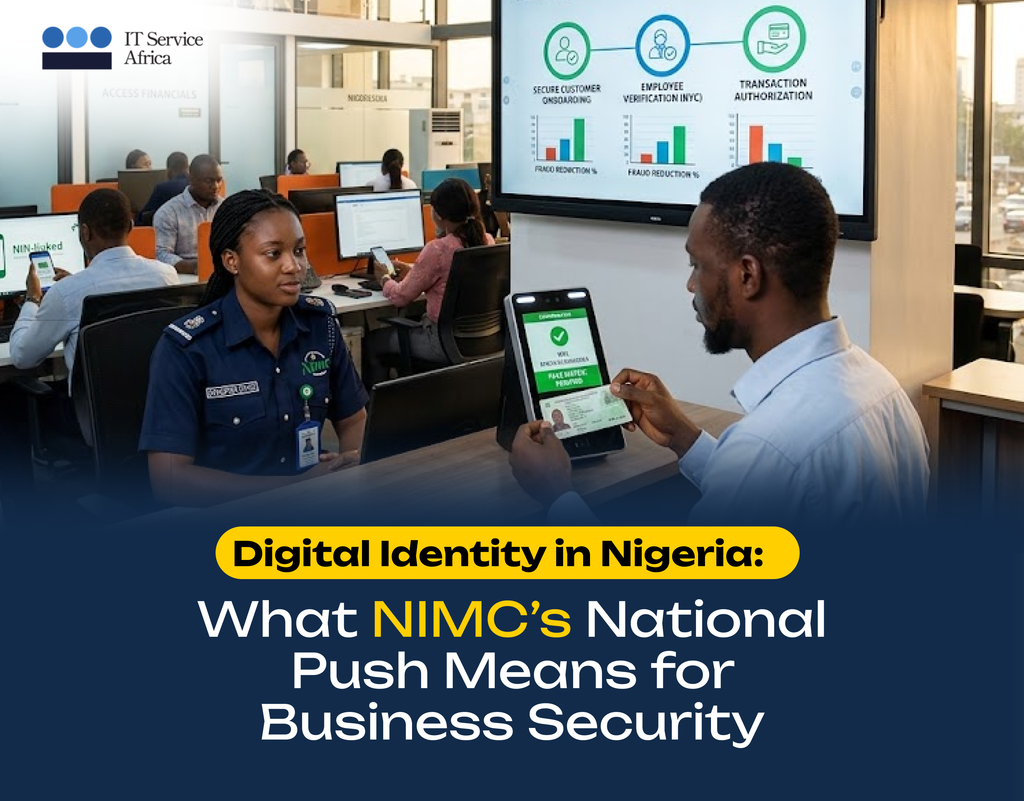
At Abuja’s ITGOV Nigeria 2026 summit, NIMC chief Abisoye Coker-Odusote warned that weak identity systems fuel financial crime, calling secure digital ID the foundation of modern economies. Why Identity Is Now a National Priority This isn’t abstract policy talk. Weak identity verification is a direct driver of fraud, account takeover, and unauthorized access — the same issues businesses across Nigeria fight every day. As the government strengthens the national identity ecosystem, internal standards for businesses are also rising. The Gap Between National Policy and Everyday Office Reality Here’s a disconnect worth searching “why does my business need access control” for: many companies are having the “secure identity” conversation at a national level while still running staff access on shared logins, unreturned ID badges, and manually tracked visitor logs on paper. If identity theft is a national security concern, it’s also a very real, very immediate business continuity concern. What a Modern Staff Digital Identity & Access System Looks Like ITSA’s Community Card unifies staff identity, facility access, and digital audit trails into one secure system. See how it works at itserviceafrica.com.

Cybersecurity in Nigeria 2026: Why the Country Ranks 110th for Fraud Protection

Artificial Intelligence, Blogs

A new report explains exactly why that search matters right now. The Compliance Reckoning: Regulating Financial Services in the Age of AI produced by Adhere and TechCabal found that Nigeria processes more than 10 billion real-time transactions a year, yet ranks 110th out of 112 countries for fraud protection. The same report found AI-enhanced fraud is now 4.5 times more profitable for criminals than traditional methods. Fewer Attacks, Bigger Losses Reported fraud cases actually fell by about 31% but losses per incident went up. Attackers aren’t spraying and praying anymore; they’re using AI to study specific targets and strike with precision. This is exactly the shift behind rising searches for “AI cybersecurity threats Nigeria” and “cyber fraud prevention for businesses.” Why Regulation Is Tightening So Fast The Central Bank of Nigeria has issued 17 regulatory actions on cybersecurity, data protection, and anti-money laundering in just 14 months ,six with mandatory deadlines running through 2028. A ₦15.42 billion fine on one major bank in 2025 made it clear: non-compliance is no longer just reputational risk, it’s a balance-sheet risk. This Isn’t Just a Bank Problem If you’ve ever searched “do small businesses need cybersecurity in Nigeria,” the honest answer is yes. Any business that takes digital payments, stores customer data, or runs on connected systems shares this same threat landscape usually without a bank’s compliance budget or dedicated security team. How to Build Real Protection at Your Scale ITSA’s Enterprise Cybersecurity service builds layered, AI-aware protection sized for growing businesses. Request a security assessment at itserviceafrica.com.

Employee Fraud in Nigeria: How Businesses Are Losing ₦10 Trillion a Year (And How to Stop It)

Artificial Intelligence, Blogs

The Centre for the Promotion of Private Enterprise (CPPE) recently reported that Nigeria loses an estimated ₦10 trillion annually to employee corruption and occupational fraud. According to CPPE’s Executive Director, Dr. Muda Yusuf, sophisticated crime isn’t causing the damage. Instead, it boils down to weak internal controls. What Employee Fraud Actually Looks Like in a Nigerian Business? Employee fraud rarely looks like a dramatic heist; instead, a driver logs more fuel than they actually used. The storekeeper whose inventory count never quite matches sales. The former staff member whose system access was never switched off. Small, repeated, and quiet which is exactly why it adds up to trillions before anyone notices. Fraud Prevention Tips Every Nigerian Business Should Know CPPE’s own recommendations are a good starting checklist for any business researching internal control systems for fraud prevention: The Technology Side of Fraud Prevention Most businesses searching for “fraud detection software for small business Nigeria” want something practical, not theoretical. Here’s what actually closes the gap: ITSA’s Community Card, AssetNova, and IT Audit & Compliance services help Nigerian businesses close the everyday gaps fraud slips through.  Get a free consultation at itserviceafrica.com.

AI-Powered Cybercrime Is Outrunning the Police: What That Means for Your Business

Artificial Intelligence, Blogs

A recent Interpol assessment of cybercrime across African countries revealed a sobering fact: AI played a role in 55% of the cybercrime cases surveyed in 2025. Criminals used it to write convincing phishing messages, fabricate identities, and impersonate executives and deepfake incidents reportedly increased sevenfold in a single year. Meanwhile, only a small fraction of the intelligence analysts tracking these crimes had advanced AI expertise of their own. The Uncomfortable Truth of AI Cybercrimes Attackers are adopting AI faster than the institutions meant to stop them. That gap doesn’t just affect law enforcement, it directly affects every business that assumes “we’re too small to be a target.” AI has made sophisticated social engineering cheap and scalable. A skilled attacker once spent hours writing a convincing, personalized phishing email; now, automation generates it in seconds, in your local language, using details scraped from your company’s public presence. What This Looks Like in Practice None of these require a sophisticated hacker. They require an AI tool and a target who hasn’t been trained to pause and verify. Closing the Gap Yourself Since institutional defenses are still catching up, businesses need to build their own layered protection: The Bottom Line Law enforcement will eventually catch up. Your business doesn’t have the luxury of waiting for that to happen. The businesses staying safest right now are the ones treating AI-era threats as already here — because they are. ITSA’s Enterprise Cybersecurity service builds layered, AI-aware defenses for businesses across Africa. Get a security assessment at itserviceafrica.com.

Africa Is Shifting from “Protect Data” to “Regulate AI”: Here’s What’s Changing

Artificial Intelligence, Uncategorized

For years, the central focus of African tech policy has been data protection: how to safeguard personal information. While that priority remains, a new phase is rapidly emerging. Today, more than a dozen African nations have launched AI strategies and are moving to develop enforceable AI regulations. Nigeria’s proposed National Digital Economy and E-Governance Bill would mandate licensing for organizations deploying “high-risk” AI systems, along with annual impact assessments. In March 2026, NDPC joined 60 global counterparts in issuing a joint declaration addressing AI-generated imagery and deepfakes, highlighting growing concerns over AI-fueled impersonation and financial fraud. Why the Regulatory Push Is Accelerating AI is now deeply integrated into credit scoring, facial recognition, digital lending, and fraud detection across African markets. Regulators are stepping in to establish safeguards before the gap between technological advancement and oversight widens further. What This Means for Businesses Using AI The Strategic Advantage in Compliance Organizations that proactively adopt responsible AI practices such as thorough documentation, human-in-the-loop controls, and bias audits won’t only reduce legal exposure. They’ll also position themselves as trusted partners for regulators and enterprises, especially as compliant AI becomes a mandatory criterion in procurement, not just an optional benefit. Rules are still evolving. Those who engage early won’t just adapt, they’ll help shape how these regulations take form. ITSA’s Process Re-engineering & AI team supports businesses in implementing automation with governance embedded from the start.  Get in touch at itserviceafrica.com.

Your Data Is Somewhere. Do You Actually Know Where?

Artificial Intelligence, Tech Solution, Uncategorized

Ask a Nigerian business owner where their data lives. You will hear, “In the cloud.” Ask which cloud. They go quiet. Ask where the servers are, or what the backup policy is. Finally ask what happens if the subscription lapses and they go quiet. This is not ignorance. Cloud adoption in Nigeria moved fast. It moved without a plan. It happened one subscription at a time. One problem was solved at a time. Now, company data is scattered across platforms that nobody fully controls. In 2026, the NDPA is actively enforced. This situation has real consequences. You Did Not Choose a Cloud Strategy. You Inherited One. It started with a slow accounting system. Someone suggested QuickBooks Online, Google Drive for files and Microsoft 365 for Teams. Each decision solved an immediate problem. None of them were part of a larger plan. Now, company data sits across multiple platforms. Each has different access rules and backup settings. Each has different compliance implications. Nobody has joined them together. What Are the Questions You Should Ask? The Fix Is Simpler Than You Think Most businesses do not need to move everything back on-premise. They just need clarity, what they have and where it lives and also must check if it is set up correctly. A cloud audit typically finds 15 to 30 percent in savings. This comes from unused licences alone. Beyond savings, it surfaces compliance gaps. It highlights security misconfigurations that most businesses carry without knowing. ITSA helps businesses across Nigeria run that audit, close the gaps and build a setup that is secure and compliant. It is built for how your business actually runs today, not how it got set up in 2019. “We are in the cloud” is a starting point, not a strategy. 📧 support@itserviceafrica.com | 📞 07079935788

They Didn’t Hack Your System: They Hacked Your Staff

Artificial Intelligence, Device Health Management Services(DHMS), General Category, Tech news update, Tech Solution, Technology

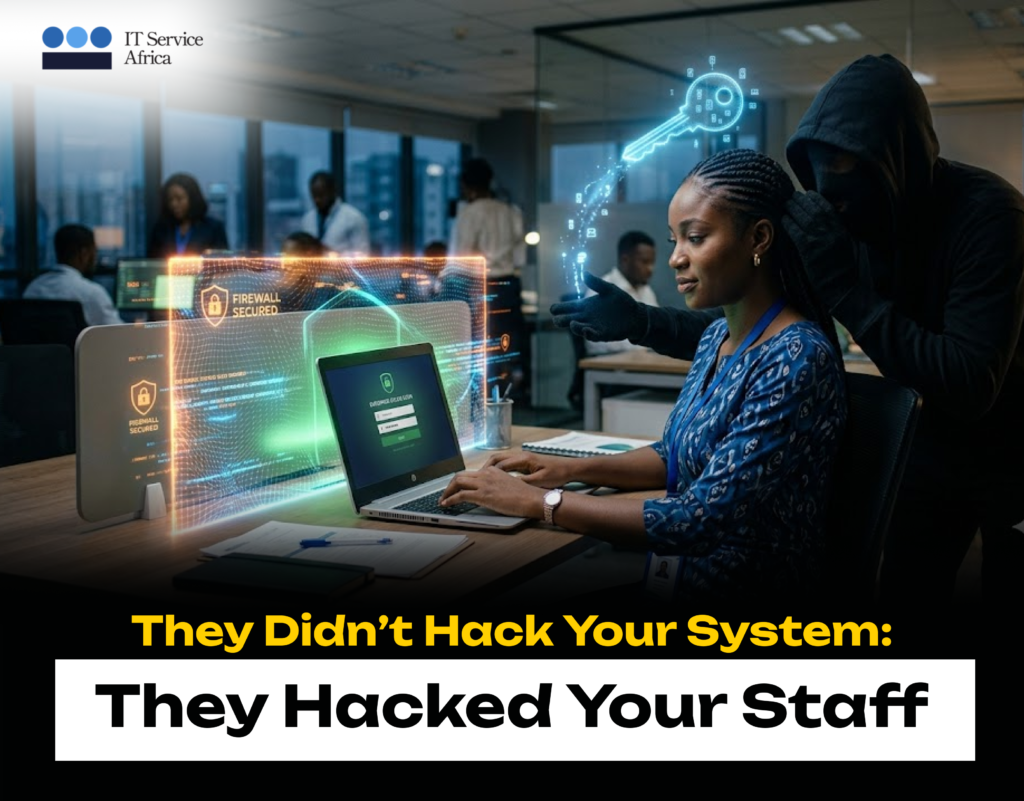
The attacker never touched a server; it took just one email, one link, and one finance officer who thought she was logging into her company’s bank portal. Three transfers left the account and nobody saw it coming because no firewall stopped it and no code triggered an alert. Someone manipulated a person in under three minutes and walked away with everything they needed. This is social engineering, and right now, it is the most common way attackers are hitting Nigerian businesses. Stop picturing a hacker in a dark room writing code. The most effective attacks today skip your systems entirely and go straight for the person at the desk. Social engineering exploits trust, urgency, fear, and the human desire to be helpful. You cannot patch those qualities out of your team, as they are what make people good at their jobs, but attackers simply know how to use them. No firewall in the world stops an employee who genuinely believes they are following a legitimate instruction. Here Is What Attackers Are Actually Doing Right Now Why Nigerian Businesses Keep Falling for This This is not a criticism of Nigerian professionals, but rather an observation about how most Nigerian organisations operate. When the MD sends an urgent message, people respond immediately. When someone calls claiming to be from the bank, the instinct is to help quickly. Similarly, when a “new IT staff member” needs access to fix something urgently, turning them away feels obstructive. Attackers study these patterns and build their entire approach around them. The speed and deference that make organisations run efficiently are the exact same qualities that social engineering turns into a weapon. Training Your People Stops This: Nothing Else Will You cannot buy a tool that fixes this problem, as no software catches every manipulated human being. What works is teaching your team to pause and to treat urgency itself as a warning sign rather than a reason to move faster. They must learn to notice when a request feels slightly off, even if they cannot immediately explain why, and feel empowered to verify without worrying about being obstructive. ITSA’s security awareness training builds these habits across your entire team through structured programmes that change real behaviour, rather than one-off sessions people forget by the end of the week. We also run simulated phishing exercises so you can see the actual numbers—how many people click, what changes after training, and where the gaps remain. One trained person can stop an attack that no firewall would have caught, while one untrained person can undo everything. Which type does your team have more of right now? Book a security awareness session for your team today.  📧 support@itserviceafrica.com

The “Smart Hustle”: Why AI is the Secret Sauce for the Modern African Enterprise

Artificial Intelligence

The Feeling: Beyond the “Robot Apocalypse” Memes  If you’ve spent any time on social media lately, you’ve seen the memes: robots taking over the world, or AI accidentally writing a “Naija” love letter that sounds a bit too stiff but in the boardrooms and the industrial zones, the conversation about Artificial Intelligence (AI) is much more grounded.  It’s not about science fiction; it’s about a very real, very human desire to stop wasting time on the boring stuff so we can focus on the big wins. The Struggle: Death by a Thousand Manual Tasks  Let’s be real, the “African Hustle” is legendary, but it’s often slowed down by what we call “digital friction.” We’re talking about that mountain of invoices waiting for manual data entry, or the constant human errors in repetitive workflows that lead to “Oga” having to sign off on the same document five times.  This isn’t just tiring; it’s an efficiency killer in a global market that doesn’t wait for anyone. At IT Service Africa (ITSA), we see AI as the tool that finally lets you work smarter, not harder. Process Re-engineering: Giving Your Business a Brain Upgrade  We don’t just “drop” AI into your office and wish you luck. Our Transformation Journey starts by looking at your current bottlenecks. We use Process Re-engineering to analyze and redesign how you work, then supercharge those new paths with: The Human Outcome: Productivity with a Smile  The goal of AI-driven intelligence isn’t to replace the brilliant minds in your office; it’s to free them so that they can stay innovative. In the industrial sector, this looks like AssetNova, which uses AI to predict equipment failure with 94%+ accuracy, saving companies 30-40% in costs. That’s not just “tech”—that’s a better bottom line and a less stressed-out workforce. Your Partner in the Digital Age As a 100% Nigerian-owned company with a Pan-African focus, we understand that our businesses need technology that is both world-class and practical. We build custom AI/ML models that fit the unique challenges of the continent, ensuring your operations are streamlined and data-driven. Are you ready to move from the “Manual Past” to the “Intelligent Future”?  [Schedule an AI Discovery Session with ITSA today] and let’s see how we can automate your success.

The Crystal Ball for Industry: How AssetNova is Ending the Guessing Game

Artificial Intelligence, Blogs

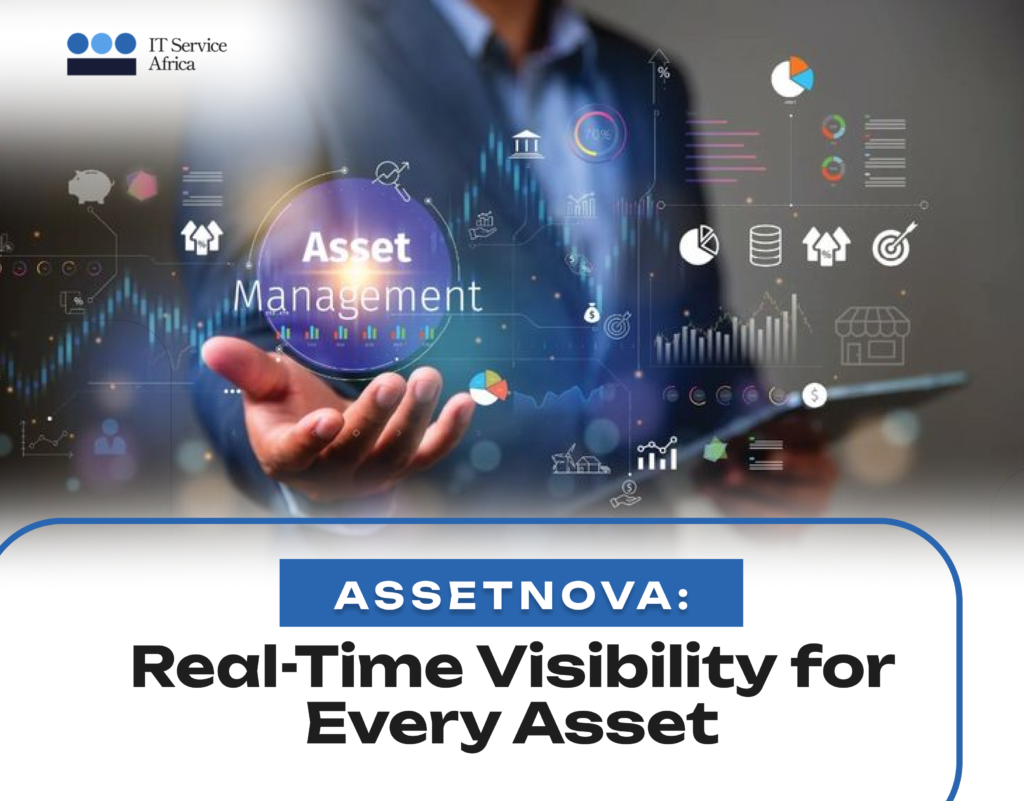
The High Cost of “The Machine is Down”  In the world of manufacturing, mining, and oil & gas, the most expensive sound is silence—the silence of a machine that has unexpectedly stopped working. For years, the industry standard was to “wait and see,” fixing expensive equipment only after it failed. It’s a stressful, expensive way to live. But what if you could see the future? Meet Your New Best Friend: AssetNova  AssetNova is our AI Asset Intelligence platform, designed to be the “crystal ball” for critical infrastructure. It connects directly to your existing SCADA and IoT sensors to perform real-time ML analysis. Instead of waiting for a breakdown, AssetNova spots the tiny anomalies—the digital “coughs”—that signal a future failure. 94% Accuracy is Not a Typo This isn’t just high-tech hype. Asset Nova delivers a staggering 94%+ prediction accuracy. By predicting failures before they happen, our partners see a 30-40% reduction in maintenance costs. It even prescribes actions, automatically generating work orders and planning crew schedules so you are always one step ahead. In a tight global economy, this kind of efficiency is the difference between leading the market and falling behind. Stop guessing and start predicting.  Discover the power of AssetNova AI.

Predictive Maintenance: How Nigerian Industries Are Preventing Downtime with AI

Artificial Intelligence, Blogs, Managed Services, Tech news update

Equipment failure is expensive anywhere. In Nigeria, where supply chains are long, technical expertise is scarce, and margins are tight, unplanned downtime can be catastrophic. A single generator failure during peak production, a conveyor breakdown at a critical moment, or a pump failure at an industrial site creates costs far beyond the repair bill. AssetNova changes this equation. By predicting failures before they happen, this AI-powered platform helps Nigerian organizations shift from reactive firefighting to proactive control thereby transforming maintenance from cost center to competitive advantage. The Maintenance Challenge in Nigerian Industry Nigeria’s industrial sector faces distinctive pressures: Traditional maintenance approaches either “run until it breaks” or rigid scheduled maintenance all fail to address these realities efficiently. The True Cost of Equipment Failure When critical assets fail unexpectedly, Nigerian businesses pay multiple prices: Immediate Production Losses Every hour of stopped production is revenue lost forever. For a manufacturing line generating ₦10 million daily, a two-day outage costs ₦20 million in lost output alone. Emergency Repair Premiums Rush shipping for parts, overtime labor, and expedited service contracts multiply normal maintenance costs by 3-5x or more. Secondary Damage Initial failures often cascade damaging connected equipment, contaminating production batches, or creating safety incidents. Customer and Contract Penalties Missed delivery deadlines, broken service agreements, and damaged relationships create lasting business consequences. Regulatory and Safety Risks Equipment failures in regulated industries create compliance violations and potential liability exposure. How AssetNova Predicts and Prevents Failure AssetNova applies machine learning to equipment data transforming maintenance from calendar-based guesswork to condition-based precision: Continuous Monitoring Sensors track vibration, temperature, pressure, electrical current, and other indicators of equipment health. Data flows from SCADA systems, PLCs, IoT devices, and historians into a unified analytics platform. Pattern Recognition AI models learn normal operating patterns for each asset and then detect subtle deviations indicating developing problems. These patterns are invisible to human observation but obvious to machine intelligence. Failure Prediction Rather than vague “something might be wrong” alerts, AssetNova provides specific failure predictions with confidence intervals and time horizons—”Bearing failure likely in 14-21 days” rather than “Check bearing.” Prescriptive Action The platform automatically generates work orders, schedules maintenance crews, orders required parts, and optimizes maintenance timing to minimize production impact. Continuous Learning As more data accumulates, prediction accuracy improves. AssetNova achieves 94%+ prediction accuracy in typical deployments, with 30-40% total maintenance cost reduction. Designed for Nigerian Industrial Realities AssetNova addresses specific challenges Nigerian organizations face: Air-Gapped and Hybrid Deployment For security-sensitive operations in energy, defense, and critical infrastructure, AssetNova deploys in isolated environments without external connectivity maintaining security while delivering intelligence. Integration with Existing Infrastructure The platform connects with existing SCADA systems, historians, and control systems without requiring wholesale infrastructure replacement protecting capital investment. Support for Critical Industries Rapid ROI Typical implementations show return on investment within 6-8 weeks through prevented failures and optimized maintenance scheduling. The Transformation Journey Implementing predictive maintenance follows a structured path: Assessment Review current maintenance practices, identify critical assets, and evaluate data availability. Data Integration Connect relevant data sources—SCADA, IoT sensors, maintenance records, operational parameters. Model Training AI models learn equipment-specific patterns using historical data, refined through expert input. Pilot Validation Test predictions against actual outcomes, refine thresholds, and build organizational confidence. Scale and Optimize Expand to additional assets, integrate with maintenance management systems, and continuously improve. Building Resilient Operations For Nigerian industries, AssetNova enables: Conclusion AssetNova provides the predictive intelligence organizations need to transform maintenance from reactive cost to proactive advantage. For Nigerian manufacturers, energy operators, miners, and critical infrastructure providers, AI-powered predictive maintenance is no longer futuristic technology. It is available, proven, and essential for sustainable operations.

Scroll to Top