IT Service Africa

Ebuka Adimora

Digital Identity in Nigeria: What NIMC’s National Push Means for Business Security
Artificial Intelligence, Blogs, Tech Solution, Technology

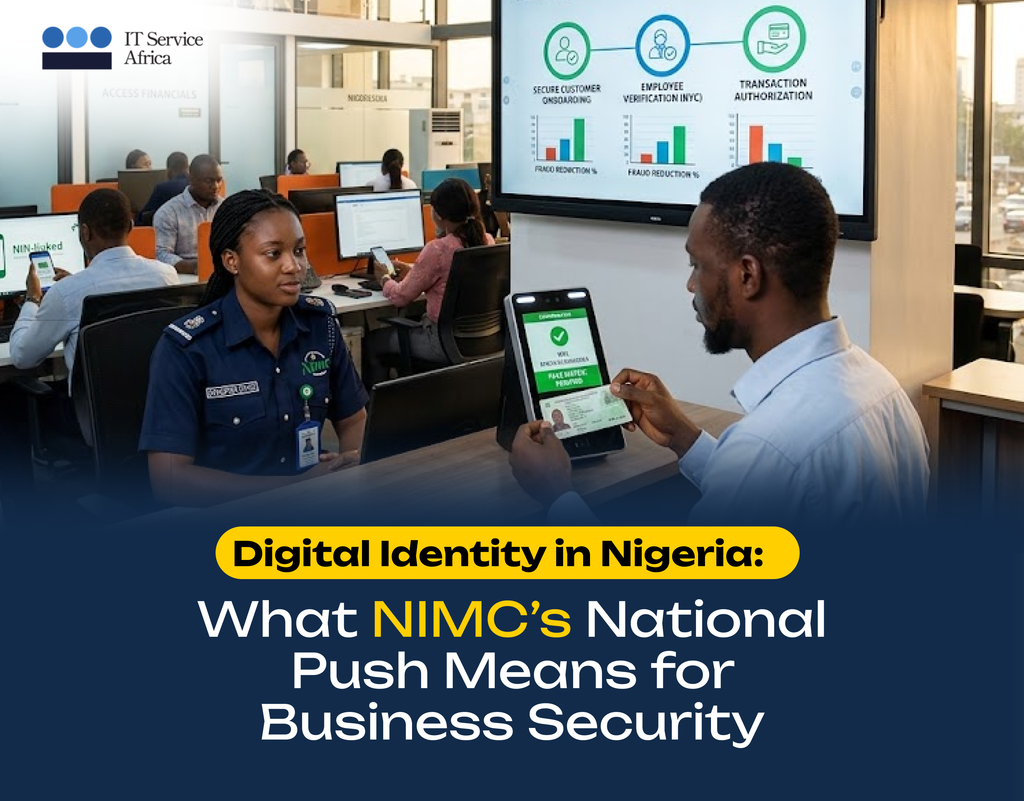
At Abuja’s ITGOV Nigeria 2026 summit, NIMC chief Abisoye Coker-Odusote warned that weak identity systems fuel financial crime, calling secure digital ID the foundation of modern economies. Why Identity Is Now a National Priority This isn’t abstract policy talk. Weak identity verification is a direct driver of fraud, account takeover, and unauthorized access — the same issues businesses across Nigeria fight every day. As the government strengthens the national identity ecosystem, internal standards for businesses are also rising. The Gap Between National Policy and Everyday Office Reality Here’s a disconnect worth searching “why does my business need access control” for: many companies are having the “secure identity” conversation at a national level while still running staff access on shared logins, unreturned ID badges, and manually tracked visitor logs on paper. If identity theft is a national security concern, it’s also a very real, very immediate business continuity concern. What a Modern Staff Digital Identity & Access System Looks Like ITSA’s Community Card unifies staff identity, facility access, and digital audit trails into one secure system. See how it works at itserviceafrica.com.

Cybersecurity in Nigeria 2026: Why the Country Ranks 110th for Fraud Protection

Artificial Intelligence, Blogs

A new report explains exactly why that search matters right now. The Compliance Reckoning: Regulating Financial Services in the Age of AI produced by Adhere and TechCabal found that Nigeria processes more than 10 billion real-time transactions a year, yet ranks 110th out of 112 countries for fraud protection. The same report found AI-enhanced fraud is now 4.5 times more profitable for criminals than traditional methods. Fewer Attacks, Bigger Losses Reported fraud cases actually fell by about 31% but losses per incident went up. Attackers aren’t spraying and praying anymore; they’re using AI to study specific targets and strike with precision. This is exactly the shift behind rising searches for “AI cybersecurity threats Nigeria” and “cyber fraud prevention for businesses.” Why Regulation Is Tightening So Fast The Central Bank of Nigeria has issued 17 regulatory actions on cybersecurity, data protection, and anti-money laundering in just 14 months ,six with mandatory deadlines running through 2028. A ₦15.42 billion fine on one major bank in 2025 made it clear: non-compliance is no longer just reputational risk, it’s a balance-sheet risk. This Isn’t Just a Bank Problem If you’ve ever searched “do small businesses need cybersecurity in Nigeria,” the honest answer is yes. Any business that takes digital payments, stores customer data, or runs on connected systems shares this same threat landscape usually without a bank’s compliance budget or dedicated security team. How to Build Real Protection at Your Scale ITSA’s Enterprise Cybersecurity service builds layered, AI-aware protection sized for growing businesses. Request a security assessment at itserviceafrica.com.

Employee Fraud in Nigeria: How Businesses Are Losing ₦10 Trillion a Year (And How to Stop It)

Artificial Intelligence, Blogs

The Centre for the Promotion of Private Enterprise (CPPE) recently reported that Nigeria loses an estimated ₦10 trillion annually to employee corruption and occupational fraud. According to CPPE’s Executive Director, Dr. Muda Yusuf, sophisticated crime isn’t causing the damage. Instead, it boils down to weak internal controls. What Employee Fraud Actually Looks Like in a Nigerian Business? Employee fraud rarely looks like a dramatic heist; instead, a driver logs more fuel than they actually used. The storekeeper whose inventory count never quite matches sales. The former staff member whose system access was never switched off. Small, repeated, and quiet which is exactly why it adds up to trillions before anyone notices. Fraud Prevention Tips Every Nigerian Business Should Know CPPE’s own recommendations are a good starting checklist for any business researching internal control systems for fraud prevention: The Technology Side of Fraud Prevention Most businesses searching for “fraud detection software for small business Nigeria” want something practical, not theoretical. Here’s what actually closes the gap: ITSA’s Community Card, AssetNova, and IT Audit & Compliance services help Nigerian businesses close the everyday gaps fraud slips through.  Get a free consultation at itserviceafrica.com.

AI-Powered Cybercrime Is Outrunning the Police: What That Means for Your Business

Artificial Intelligence, Blogs

A recent Interpol assessment of cybercrime across African countries revealed a sobering fact: AI played a role in 55% of the cybercrime cases surveyed in 2025. Criminals used it to write convincing phishing messages, fabricate identities, and impersonate executives and deepfake incidents reportedly increased sevenfold in a single year. Meanwhile, only a small fraction of the intelligence analysts tracking these crimes had advanced AI expertise of their own. The Uncomfortable Truth of AI Cybercrimes Attackers are adopting AI faster than the institutions meant to stop them. That gap doesn’t just affect law enforcement, it directly affects every business that assumes “we’re too small to be a target.” AI has made sophisticated social engineering cheap and scalable. A skilled attacker once spent hours writing a convincing, personalized phishing email; now, automation generates it in seconds, in your local language, using details scraped from your company’s public presence. What This Looks Like in Practice None of these require a sophisticated hacker. They require an AI tool and a target who hasn’t been trained to pause and verify. Closing the Gap Yourself Since institutional defenses are still catching up, businesses need to build their own layered protection: The Bottom Line Law enforcement will eventually catch up. Your business doesn’t have the luxury of waiting for that to happen. The businesses staying safest right now are the ones treating AI-era threats as already here — because they are. ITSA’s Enterprise Cybersecurity service builds layered, AI-aware defenses for businesses across Africa. Get a security assessment at itserviceafrica.com.

Why Is So Much of Africa’s Data Still Hosted Abroad?

Blogs, General Category, Managed Services, Weekly update

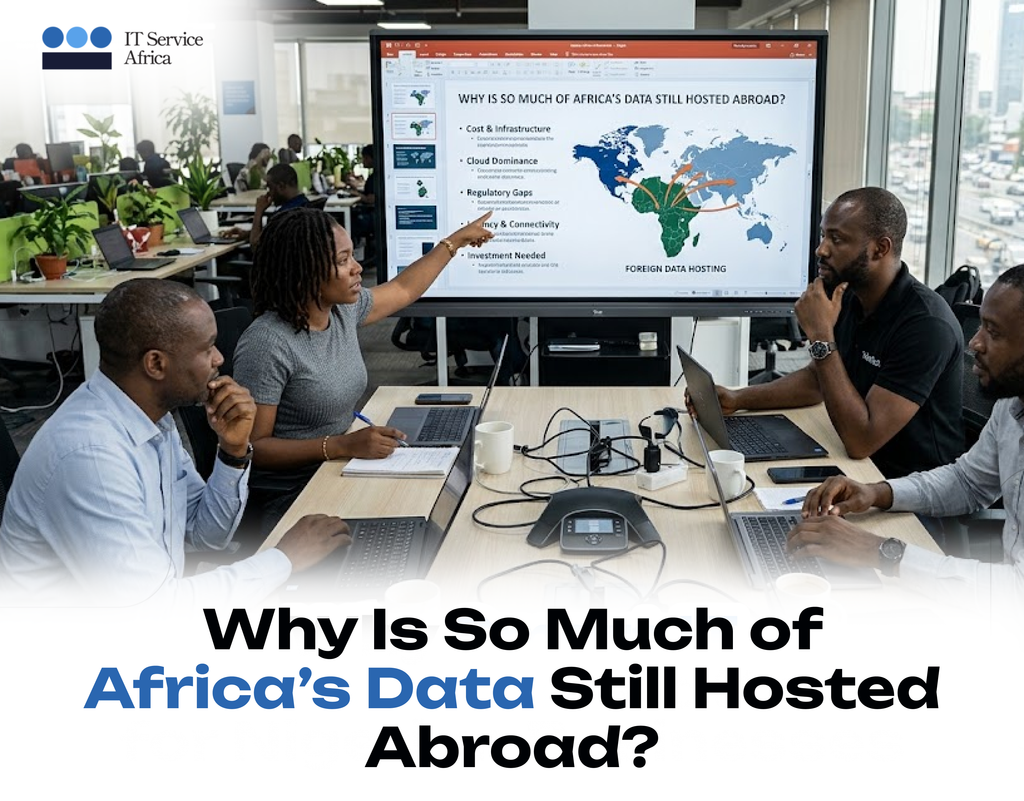
Here’s a question worth sitting with: when your business “saves to the cloud,” where does that data actually live? For a large share of African enterprises, the honest answer is Frankfurt, Dublin, or another European data hub not anywhere on the continent. How This Happened For decades, hosting data abroad was simply the practical choice. International hubs offered reliable power, dense connectivity, and mature infrastructure that local alternatives struggled to match often due to power instability, limited data center capacity, and financing constraints. Businesses weren’t being careless; they were optimizing for uptime in the infrastructure that existed. The Problem That’s Now Catching Up Countries including Nigeria and Kenya have significantly strengthened their data governance laws in the past two years. But there’s a widening gap between what regulation expects data sovereignty, local accountability, fast breach response and where the data actually sits. Hosting sensitive customer data outside the country your regulator operates in adds legal complexity, latency, and risk that many businesses haven’t fully priced in. What Local-First Infrastructure Actually Solves What Businesses Can Do Today You don’t need to build your own data center to fix this. A proper IT infrastructure design and implementation review can map exactly where your critical data lives, whether that’s still the right call, and what a realistic migration to local or hybrid infrastructure would look like without disrupting operations in the process. The infrastructure conversation in Africa is no longer just about getting online. It’s about deciding, deliberately, where your business’s most valuable asset, its data actually belongs. ITSA designs and deploys cloud, hybrid, and on-premise IT infrastructure built for African operating realities. Explore the service at itserviceafrica.com.

Africa Is Shifting from “Protect Data” to “Regulate AI”: Here’s What’s Changing

Artificial Intelligence, Uncategorized

For years, the central focus of African tech policy has been data protection: how to safeguard personal information. While that priority remains, a new phase is rapidly emerging. Today, more than a dozen African nations have launched AI strategies and are moving to develop enforceable AI regulations. Nigeria’s proposed National Digital Economy and E-Governance Bill would mandate licensing for organizations deploying “high-risk” AI systems, along with annual impact assessments. In March 2026, NDPC joined 60 global counterparts in issuing a joint declaration addressing AI-generated imagery and deepfakes, highlighting growing concerns over AI-fueled impersonation and financial fraud. Why the Regulatory Push Is Accelerating AI is now deeply integrated into credit scoring, facial recognition, digital lending, and fraud detection across African markets. Regulators are stepping in to establish safeguards before the gap between technological advancement and oversight widens further. What This Means for Businesses Using AI The Strategic Advantage in Compliance Organizations that proactively adopt responsible AI practices such as thorough documentation, human-in-the-loop controls, and bias audits won’t only reduce legal exposure. They’ll also position themselves as trusted partners for regulators and enterprises, especially as compliant AI becomes a mandatory criterion in procurement, not just an optional benefit. Rules are still evolving. Those who engage early won’t just adapt, they’ll help shape how these regulations take form. ITSA’s Process Re-engineering & AI team supports businesses in implementing automation with governance embedded from the start.  Get in touch at itserviceafrica.com.

Nigeria Just Tightened Data Governance: Is Your Business Actually Ready?

Uncategorized

In late July 2026, the Nigerian government issued a compliance circular directing every federal ministry, department, and agency to strengthen how they handle personal data, under the Nigeria Data Protection Act (NDPA) 2023.  Around the same time, the Nigeria Data Protection Commission (NDPC) signed a formal agreement with the National Broadcasting Commission to deepen data governance across the digital and broadcasting sectors and confirmed that Nigeria’s data protection industry is now worth an estimated ₦16.3 billion. The signal is clear: data governance in Nigeria has moved from guideline to enforcement. What “Compliance First” Actually Means NDPC leadership has described its approach as “compliance first, not punishment” — encouraging organizations to fix gaps collaboratively before sanctions come into play.  That’s good news, but it comes with a catch: the grace period only helps businesses that use it. Regulators are increasingly building regulatory sandboxes, data privacy innovation labs, and cross-agency enforcement partnerships, the infrastructure of a system that’s preparing to move from encouragement to accountability. Three Questions Every Business Should Be Asking Right Now Why This Is Bigger Than Fines Beyond avoiding penalties, strong data governance is becoming a competitive differentiator. As Nigeria positions itself as a serious destination for digital investment, businesses that can prove compliance will win contracts and partnerships that non-compliant competitors simply can’t access. Data governance is no longer a legal department problem. It’s a business survival issue and it starts with an honest audit of where you actually stand today. ITSA’s IT Audit & Compliance service helps businesses map data flows, close gaps, and stay ahead of NDPC requirements. Talk to us at itserviceafrica.com.

Your Remote Team Is Working From 47 Different Networks. Is Any of Them Safe?

Blogs, Managed Services

Before 2020, securing a Nigerian business meant protecting the physical office premises. You knew what was inside those walls, and you protected it. Then, remote work happened. The walls disappeared, and most IT strategies never caught up. WHAT REMOTE WORK DID TO YOUR SECURITY POSTURE ? A fifty-person organisation today might have staff working from homes across Lagos, Abuja, and Port Harcourt. They use personal WiFi connections, shared family routers, and café hotspots when the power goes out. Some use company laptops, while others use personal devices. Many bypass the VPN entirely because it slows down their internet connection. This means you have forty-seven different networks, but only one company dataset. A single breach on any of these networks touches everything. The firewall protecting your main office cannot reach a home router in Surulere. Your network monitoring system cannot see what happens on mobile data in Kano. When a remote worker uploads files to a personal Google Drive to save time, IT rarely finds out until data leaks. THREE CONTROLS THAT ACTUALLY FIX REMOTE SECURITY: IT Service Africa deploys three modern solutions to recreate office-level security for your distributed team: ADAPTING TO THE FUTURE OF NIGERIAN WORK The forty-seven networks are not going away. Distributed and hybrid work is now a permanent reality for Nigerian knowledge-work organisations. Your security strategy needs to reflect this reality, not the office environment that existed in 2019. Protect your business data across every home, café, and remote location. Book a remote work security assessment →  📧 support@itserviceafrica.com

How One Leaked Password Can Destroy Your Corporate Security

Blogs

A predictable conversation happens in Nigerian IT teams after a security incident. Someone asks what password the affected account was using. There is a long pause and then you find out it was the same password used for everything. HOW ONE LEAKED PASSWORD OPENS EVERY DOOR? Password reuse is not laziness. It is a response to an impossible situation. No one can remember unique, complex passwords across dozens of corporate platforms. However, people pick one simple password and use it everywhere. That single decision is highly dangerous for your business. In 2024, a food delivery app suffered a major data breach. A staff member at a Nigerian firm used the exact same password for both that app and his work account. Attackers used automated tools to test this leaked password across hundreds of platforms. They found a match within hours. The firm’s Microsoft 365 account opened instantly. Client contracts, wire transfer records, and customer personal data were all exposed. Nobody hacked the system. The criminals simply tried a key they found on the floor. THREE STEPS TO SECURE YOUR BUSINESS WITH IT SERVICE AFRICA: IT Service Africa deploys three critical solutions to stop these credential attacks completely: THE TRUE COST OF A CORPORATE BREACH: A data breach triggered by one reused password typically costs between ₦20,000,000 and several hundred million naira. This includes investigation costs, NDPA regulatory penalties, and client remediation. By contrast, IT Service Africa can implement a password manager for fifty staff members for roughly ₦3,000,000 per year. The maths are not complicated.

Upgrade Corporate Security with the Community Card

Managed Services, Uncategorized

Most Nigerian office buildings have a security guard at the entrance. Visitors write their names in a paper logbook. Then, nobody ever reads it again. That logbook is not real security. It is just the appearance of security. This gap between appearance and reality is exactly where office break-ins happen. The Security Risks You Live With Daily Think about what actually happens in your building today: None of this is true access control. It is just hope. In 2026, hope is not a security strategy. Eliminate Vulnerabilities with Community Card Community Card is the automated smart identity and access management solution developed by IT Service Africa (ITSA). It replaces human errors with smart hardware enforced security. Every staff member carries a Community Card. Entering any secured area requires a tap of that card. The system checks permissions instantly and logs the movement automatically. Instant Deactivation: When an employee or contractor leaves the company, their Community Card is deactivated immediately Role-Based Access: A finance officer can enter the accounts office, but not the server room. A contractor can access their assigned floor, but not executive areas. Digital Audit Trails: If something goes missing, you check the digital data instantly. You can see who opened the door, and at what exact time. See how Community Card works for your organisation →  📧 support@itserviceafrica.com

Scroll to Top